
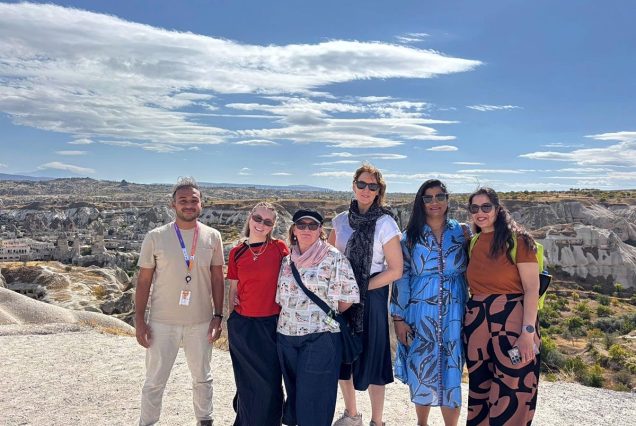
A Geological Journey Through Cappadocia’s Northern Valleys
Millions of years before the first monks chiselled prayer niches into Cappadocia’s cliffs, volcanoes were doing the real creative work. Mount Erciyes, Mount Hasan, and a chain of smaller vents blanketed the central Anatolian plateau with layer upon layer of ash, pumice, and lava. That volcanic layer cake — geologists call it ignimbrite — is the raw material from which every fairy chimney, every cave church, and every underground city was eventually carved. The Cappadocia North Tour follows the story of that stone, from its explosive birth to its patient reshaping by water, frost, and human hands.
Your day begins with hotel pickup across the Göreme–Ürgüp–Avanos triangle. The vehicle is modern and air-conditioned, and your English-speaking guide has the kind of geological enthusiasm that turns roadside outcrops into riveting narratives.
Devrent Valley — Reading the Rock Record
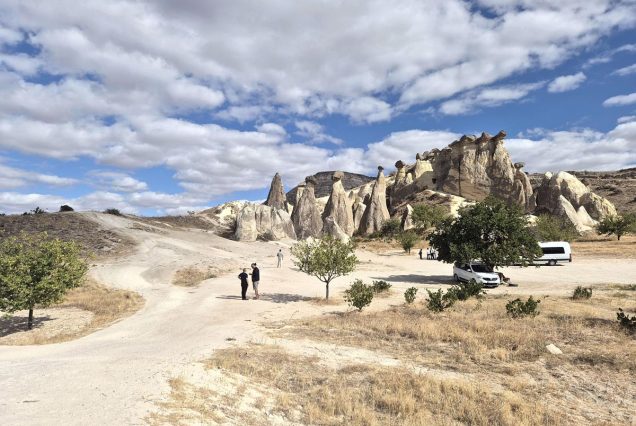
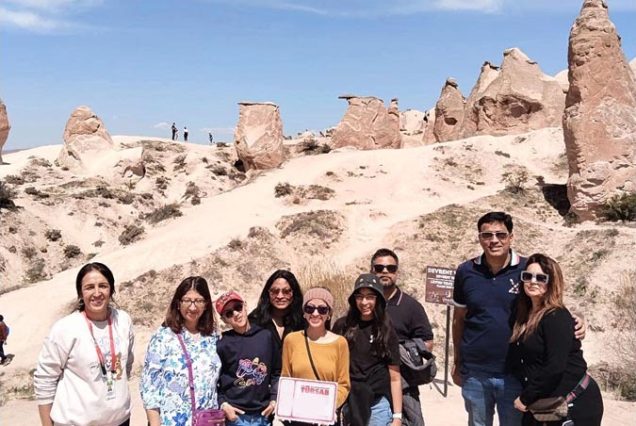
At Devrent Valley, the volcanic story is written in three dimensions. The hoodoos and pillars here form when a cap of relatively hard rock — basalt or welded tuff — protects softer layers beneath from rain erosion. Remove the cap (as happens when it finally cracks and falls) and the pillar erodes rapidly, vanishing within a few thousand years. What you see at Devrent is a snapshot in geological time: columns at every stage of their lifecycle, from fresh pillars with intact caps to eroded stumps to bare ridges where the last remnants have crumbled away.
Your guide will explain how the different colours in the cliff bands correspond to separate eruption events — a pink layer from one volcanic episode, a cream layer from another, a grey band of harder welded material that resists erosion and forms ledges. Once you understand the colour code, every valley in Cappadocia becomes legible.
Paşabağ — Erosion as Architecture
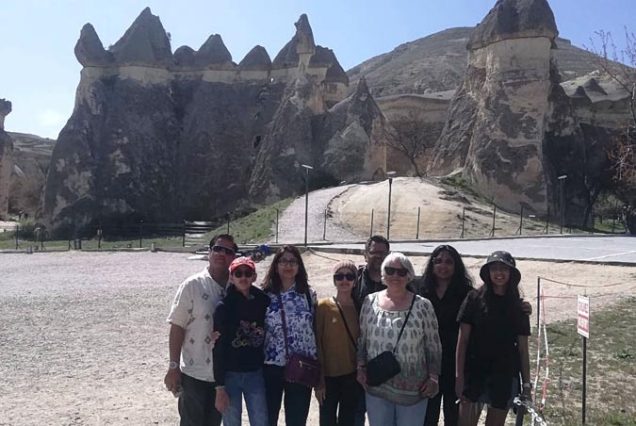
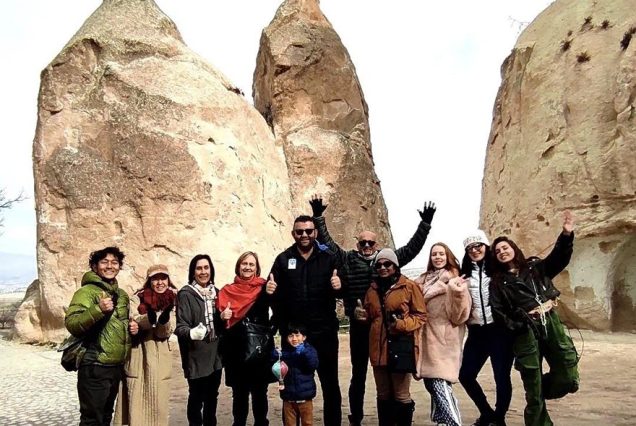
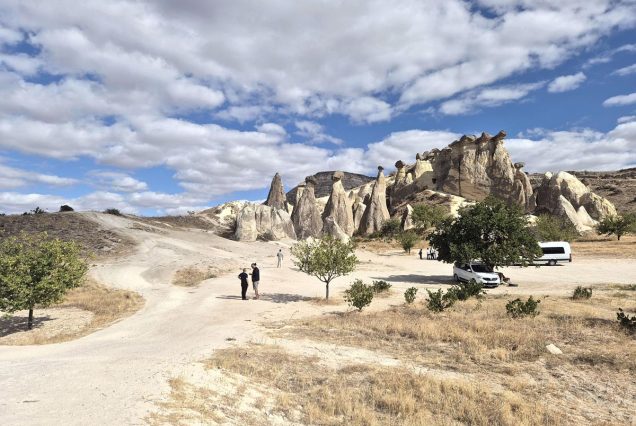
The fairy chimneys at Paşabağ are among the tallest and most structurally complex in the region. Some carry two or even three capstones, creating the “mushroom forest” effect that has become Cappadocia’s visual signature. The geological explanation is straightforward — multiple resistant layers at different heights slow the erosion of the column at different rates — but the visual result is anything but ordinary. Early Christian hermits clearly agreed: they carved cells and chapels into these pillars, trusting the same geological stability that has kept the columns standing for millennia.
Take time to walk beyond the main viewing platforms. A trail to the north-east leads past lesser-visited chimneys where the tuff is streaked with manganese oxides, giving the stone a dramatic purple-black banding.
Avanos — Where Geology Meets Craft
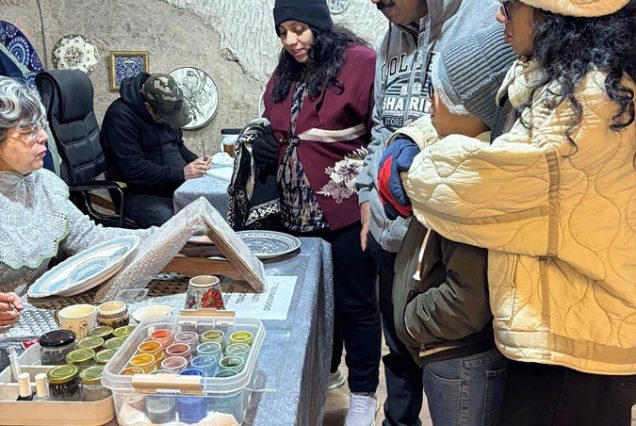
The Kızılırmak River, which bisects the town of Avanos, carries sediment eroded from the same volcanic formations you’ve been admiring all morning. That sediment — fine-grained, iron-rich, beautifully plastic when wet — has sustained a pottery industry here for at least four thousand years. In Avanos, geology is not just scenery; it’s livelihood.
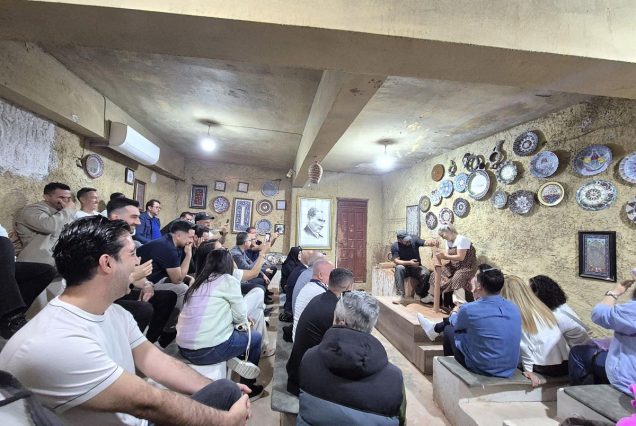
At a family workshop, a master potter demonstrates the kick-wheel technique passed down through generations. The wheel itself is a heavy stone disc set in a pit, spun by foot while hands coax the clay upward. No electricity, no bearings — just angular momentum and skill. You’ll try the wheel yourself, discovering just how much subtlety hides in what looks effortless.
Lunch follows in Avanos, featuring regional dishes: mantı (Turkish dumplings) with yoghurt and sumac, lamb testi kebab sealed in a clay vessel, and fresh produce from the volcanic soil that makes Cappadocian agriculture unexpectedly productive.
Göreme Open Air Museum — Faith Inscribed in Tuff
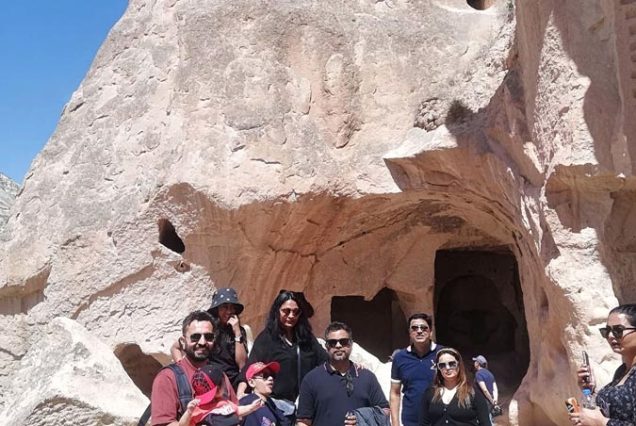
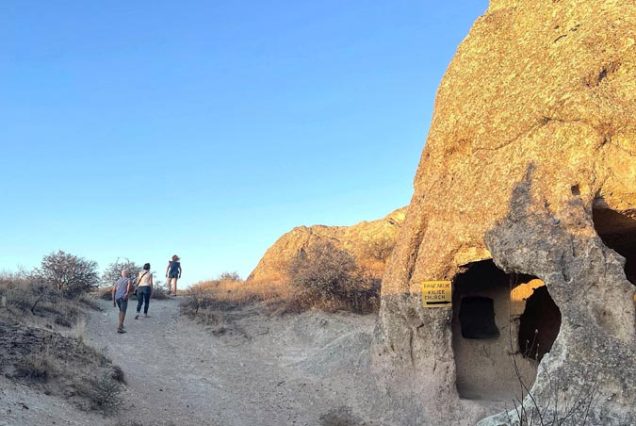
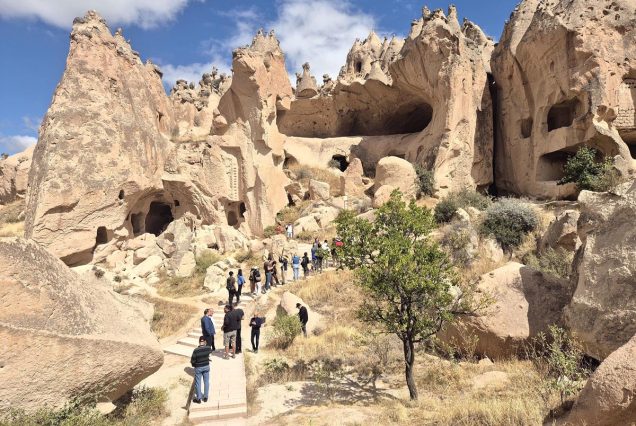
After lunch, the tour shifts from geology to the human response to it. The Göreme Open Air Museum is a UNESCO World Heritage complex of rock-cut churches dating from the 10th to 12th centuries. The monks who carved these spaces understood their material intuitively: the soft tuff was easy to excavate with simple iron tools, yet hardened on exposure to air, creating durable interiors that have survived a thousand years with minimal maintenance.
Inside the churches, Byzantine frescoes cover walls and ceilings. The Karanlık Kilise (Dark Church) is the highlight — its limited apertures kept sunlight from fading the pigments, preserving colours that rival any manuscript illumination in Istanbul’s museums. Your guide will walk you through the iconographic programme: Old Testament scenes on the lower registers, New Testament narratives above, and Christ Pantocrator gazing down from the central dome.
Göreme Panorama & Uçhisar — The View From Above
The afternoon’s final stops are about perspective. At the Göreme panoramic viewpoint, the entire northern valley system spreads below — a miniature civilisation tucked into folds of pale rock. Then the vehicle climbs to Uçhisar Castle, the region’s highest natural point. The “castle” is actually a massive rock pinnacle honeycombed with tunnels and chambers, used as a fortress, a signalling station, and a refuge throughout history. From its summit, the 360-degree panorama encompasses Erciyes Dağı, the distant Taurus mountains, and the fairy-chimney valleys you’ve spent the day exploring.
Continuing Your Cappadocia Exploration
The North Tour pairs naturally with the Cappadocia South Tour, which ventures into the underground cities and red-tinged valleys of the southern sector. Together, the two itineraries cover Cappadocia’s full geological and cultural spectrum. For travellers with a single day, the Cappadocia Red Tour offers a condensed greatest-hits approach at a lower price point.
You May Like
Cappadocia Highlights Tour
Cappadocia South Tour
Cappadocia Mix Tour
Cappadocia Red Tour
Reviews
There are no reviews yet.